# User Interface

JMap Pro's graphical interface is modular (note that there is also a simplified version of JMap Pro that does not permit the user interface to be reorganized).&#x20;

Each window can be moved to provide a customized interface. To move a window, you must click on the top portion of it, then drag and drop it to the desired area. You may want to hold down the CTRL key when moving a window to avoid automatically dropping it onto the sides of the application.&#x20;

Most windows include a set of display options located in their upper right corner, allowing you to toggle to floating mode, to enable auto-hide, and to close the window.

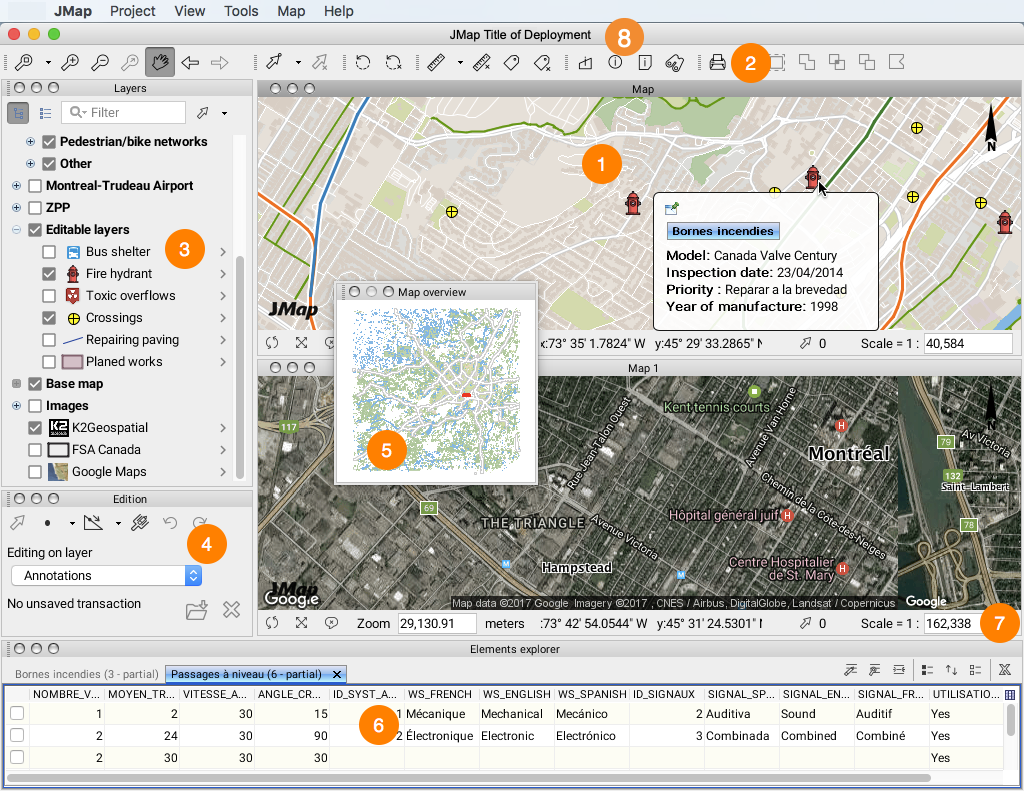
The following illustration shows the main parts of the interface.

<figure><img src="/files/8uHwNm0Zl2WOEsi0HrDC" alt=""><figcaption></figcaption></figure>

<table data-header-hidden><thead><tr><th width="76"></th><th></th></tr></thead><tbody><tr><td><strong>1</strong></td><td>Map displaying a portion of data. <br>It is possible to open several maps at once and organize them according to your needs. Each map is independent from the others. Maps are interactive and allow for easy querying of objects.</td></tr><tr><td><strong>2</strong></td><td>Toolbars and menu bars allow you to access the application's various functions.</td></tr><tr><td><strong>3</strong></td><td>The layer management window displays a hierarchical structure of the project's layers. You may turn layers on or off as needed.</td></tr><tr><td><strong>4</strong></td><td>Extensions can be added to JMap to provide new functionalities. <br>For example, the <a href="https://docs-jmapserver-lima.k2geospatial.com/v/e/extensions/edition">Edition</a> extension adds functionality to create and modify data.</td></tr><tr><td><strong>5</strong></td><td>The map overview shows the region displayed on the map in relation to the entire territory. It also allows you to access a region in a single click. <br>The overview can be activated from the <strong>View</strong> menu.</td></tr><tr><td><strong>6</strong></td><td>The elements explorer displays a tabular view of a layer's data or of selected data. <br>The table is interactively connected to the map.</td></tr><tr><td><strong>7</strong></td><td>Each map has a status bar indicating the coordinates, the scale, the number of selected elements, etc.</td></tr><tr><td><strong>8</strong></td><td>The name of the deployment may appear in the title bar.</td></tr></tbody></table>


---

# Agent Instructions: Querying This Documentation

If you need additional information that is not directly available in this page, you can query the documentation dynamically by asking a question.

Perform an HTTP GET request on the current page URL with the `ask` query parameter:

```
GET https://docs-jmapserver-lima.k2geospatial.com/e/applications/jmap-pro-user-guide/introduction/user-interface.md?ask=<question>
```

The question should be specific, self-contained, and written in natural language.
The response will contain a direct answer to the question and relevant excerpts and sources from the documentation.

Use this mechanism when the answer is not explicitly present in the current page, you need clarification or additional context, or you want to retrieve related documentation sections.
