> For the complete documentation index, see [llms.txt](https://docs-jmapserver-lima.k2geospatial.com/llms.txt). Markdown versions of documentation pages are available by appending `.md` to page URLs; this page is available as [Markdown](https://docs-jmapserver-lima.k2geospatial.com/e/applications/jmap-ng-user-guide/the-data/data-layers/layer-information.md).
# Layer Information
To display layer information:
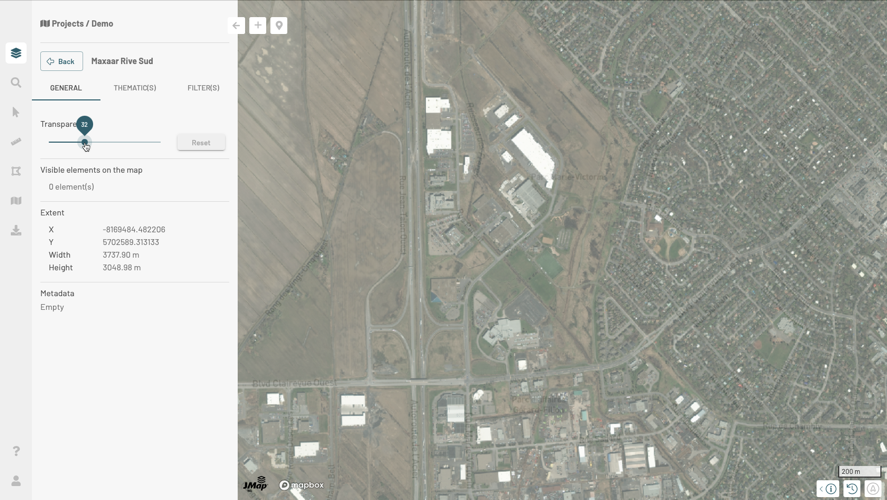
1. Click on and then on **More information** to open the **GENERAL** panel. Several information are presented there:
* Number of layer features that are visible on the map. The number varies as you navigate the map.
* Extent: X and Y indicate the position of the southwest point of the layer, width and height indicate the layer extent in meters from this point.
* Date of production: this is metadata.
* Metadata: information about the data in the layer such as quality indicators, the organization producing the data, update dates, etc.
Metadata may be missing.
2. The **Transparency** function, available for raster data layers, allows you to adjust the transparency level between 0% (default) and 100%. The transparency level is saved when you save your map ([Create and Manage Customized Maps](/e/applications/jmap-ng-user-guide/i-wish-to.../create-and-manage-customized-maps.md) section).
3. Click on the **THEMATIC(S)** and/or **FILTER(S)** tabs to display these panels.
4. Click **Back** to return to the **Layers** panel.
 and then on
  **More information** to open the **GENERAL** panel. Several information are presented there:
* Number of layer features that are visible on the map. The number varies as you navigate the map.
* Extent: X and Y indicate the position of the southwest point of the layer, width and height indicate the layer extent in meters from this point.
* Date of production: this is metadata.
* Metadata: information about the data in the layer such as quality indicators, the organization producing the data, update dates, etc.
Metadata may be missing.
2. The **Transparency** function, available for raster data layers, allows you to adjust the transparency level between 0% (default) and 100%. The transparency level is saved when you save your map ([Create and Manage Customized Maps](/e/applications/jmap-ng-user-guide/i-wish-to.../create-and-manage-customized-maps.md) section).
**More information** to open the **GENERAL** panel. Several information are presented there:
* Number of layer features that are visible on the map. The number varies as you navigate the map.
* Extent: X and Y indicate the position of the southwest point of the layer, width and height indicate the layer extent in meters from this point.
* Date of production: this is metadata.
* Metadata: information about the data in the layer such as quality indicators, the organization producing the data, update dates, etc.
Metadata may be missing.
2. The **Transparency** function, available for raster data layers, allows you to adjust the transparency level between 0% (default) and 100%. The transparency level is saved when you save your map ([Create and Manage Customized Maps](/e/applications/jmap-ng-user-guide/i-wish-to.../create-and-manage-customized-maps.md) section).